Ice Maker Repair
Hollow, cloudy or barely any cubes: hard water and a Sub-Zero ice maker
Phoenix water scales a clear-ice mould in a season. Cube shape tells you whether the fault is the water, the fill valve, the drain or the module — here is how to read it before you replace anything.
- Written by
- Warren Ibarra
- Trade
- Refrigeration technician — condenser and heat-load work · 20 years in the trade
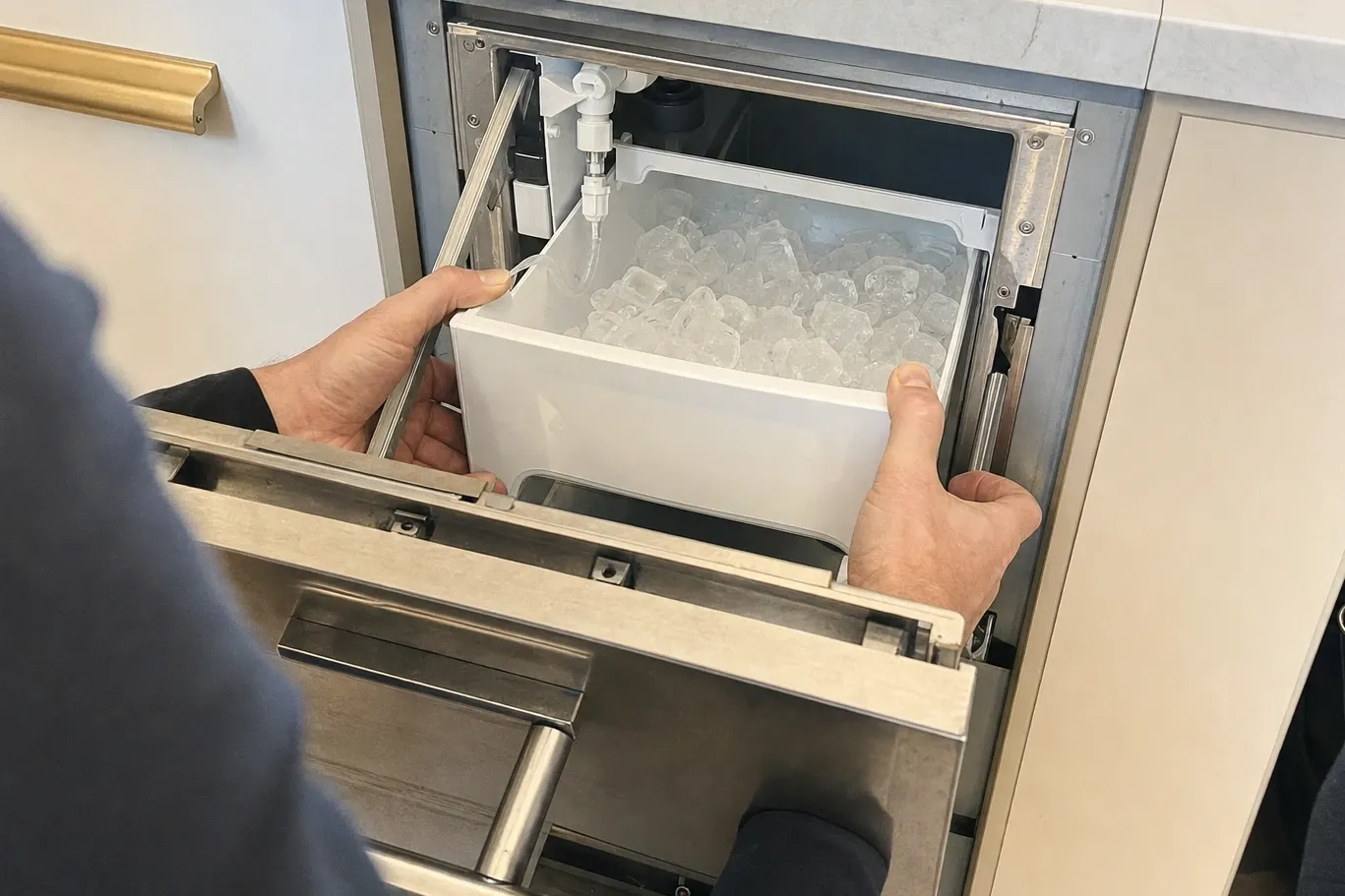
An ice maker is the part of a Sub-Zero that notices Phoenix water first. Mains supply across most of the valley is hard, and a clear-ice mould is a shallow tray that sees fresh water dozens of times a day, every day, in a warm room. Scale builds, sensors get gummed, and production tails off so gradually that most people only ring when the bin has been empty for a fortnight.
The good news is that cube shape is diagnostic. Before anybody quotes you for a module — the expensive part — you can usually narrow the fault to one of four things just by looking at what came out.
Read the cubes before you read the manual
Take out whatever is in the bin and look at it properly.
- Hollow cubes, or cubes with a soft dip in the top. The freeze cycle is ending before the mould is full. That is water flow, not refrigeration.
- Cloudy or white-cored cubes. The fill is too fast or too mineral-heavy. Air and dissolved solids get trapped instead of being pushed out as the cube freezes from the outside in.
- Cubes fused into a slab. The harvest is not clearing properly, or meltwater is refreezing in the bin because the drain is blocked.
- Small, uneven or very few cubes. Usually scale on the mould and the thermistor, so the control never sees the temperature it is waiting for.
- No cubes at all, and no water sound. Supply side: shut-off, line, filter or fill valve.
That single look will save you an hour of pulling things apart, and it is the first thing we ask about on the phone.
Scale is the Phoenix fault
A clear-ice maker works by flooding a mould, freezing it slowly, then warming the mould just enough to release a slab and cut it. Every one of those steps is degraded by mineral build-up.
You will see white crust around the mould rim and a chalky film on the metal. What you will not see is the same deposit on the temperature sensor, which is what actually stops production: the control waits for a reading that arrives late or never, so cycles get longer and fewer until they stop. Descaling with a proper ice machine cleaner, changing the water filter and cleaning the sensor bring a surprising number of “dead” makers back — and it is the first thing we do rather than the last.
Two habits make it worse in this climate. Skipping filter changes, obviously. And switching the maker off over summer holidays, which leaves standing mineral water in the mould to dry solid.
Water supply, in the order it fails
If descaling has not changed anything, follow the water backwards.
- The shut-off valve. Often a saddle valve under the sink or behind the cabinet, and often barely open. It only needs a partial turn to starve a clear-ice cycle.
- The line itself. Copper or plastic tubing that was routed behind a cabinet during a remodel and kinked when the unit was pushed back. Very common on downtown loft installations where nothing has room to spare.
- The filter. A blocked filter throttles flow exactly like a failing valve does, and it is a five-minute swap.
- The fill valve. An electrically fine valve can still be mechanically restricted by scale. This is what most hollow-cube complaints turn out to be.
Only after all four does the module become the likely answer. Modules do seize, and when they do the fix is a replacement fitted on the visit — but replacing one because nobody checked the water is how people end up with the same fault six months later.
Undercounter makers drain, and that changes things
A built-in freezer’s ice maker melts back into the compartment drain. An undercounter clear-ice maker has its own drain — often with a pump — and that adds two failure modes worth knowing about.
If the pump fails, water backs up under the bin, the bin sensor stops reading correctly and production stops. From the outside it looks like a dead machine. If the drain line is blocked or has been run with a rising loop by whoever installed it, you get intermittent flooding and cubes that fuse into a block.
Water on the floor beneath an undercounter unit is a drain fault far more often than it is a split supply line. It is worth checking before you assume the worst, because the repair is usually a pump and a clean rather than anything structural.
When it is worth having someone out
Ring when any of these are true, because they are the points where guesswork gets expensive:
- Production has dropped and descaling plus a new filter changed nothing.
- The mould fills but the harvest never releases, or releases into a fused slab.
- There is water on the freezer floor or under an undercounter cabinet.
- The maker is silent with the supply confirmed open and the filter new.
- The bin light or the display is reporting a fault the manual points at the control board.
A visit here is measurement rather than opinion: flow at the valve, resistance across the thermistor, continuity through the harvest heater, and a watched cycle from fill to release. The $89 service call covers that diagnosis and comes off the repair if you go ahead — and quite often the answer is a valve, a filter and an hour with a descaler rather than the new machine you were braced for.
Follow-up questions
How often does the water filter actually need changing here?
Sub-Zero specify roughly every twelve months, but on Phoenix mains water most makers we see do better on a shorter interval. If output has dropped and the cubes have gone cloudy, the filter is the cheapest thing to rule out first.
Can I descale a clear-ice mould myself?
A proper cleaner made for ice machines, run through per the manual, is fine and worth doing. What is not fine is vinegar left standing in the mould or anything abrasive on the surface — both will cost you more than the scale did.
Why is my ice cloudy when the same maker used to produce clear cubes?
Clear ice depends on a slow, steady fill and a full freeze cycle. Restrict the water — a throttling valve, a kinked line, a half-open shut-off, a blocked filter — and the cube freezes too fast, trapping air and minerals. Cloudiness is a symptom of flow, not of cold.
There is water on the freezer floor under the maker. Is that the ice maker or something else?
On an undercounter maker it is usually the drain pump or the drain line. Inside a built-in freezer compartment it is more often the fill tube spitting past the mould, or a defrost drain that has frozen. All three look identical from the outside and none of them need a new machine.