Refrigerator Repair
Sub-Zero Refrigerant: Which Kind Yours Uses and Who May Touch It
A Sub-Zero refrigerator uses the refrigerant named on its rating tag: current models carry a flammable refrigerant that only specially trained technicians may service, while older units ran on a non-flammable type. Here is how that sealed system works, fails and gets repaired.
- Written by
- Warren Ibarra
- Trade
- Refrigeration technician — condenser and heat-load work · 20 years in the trade
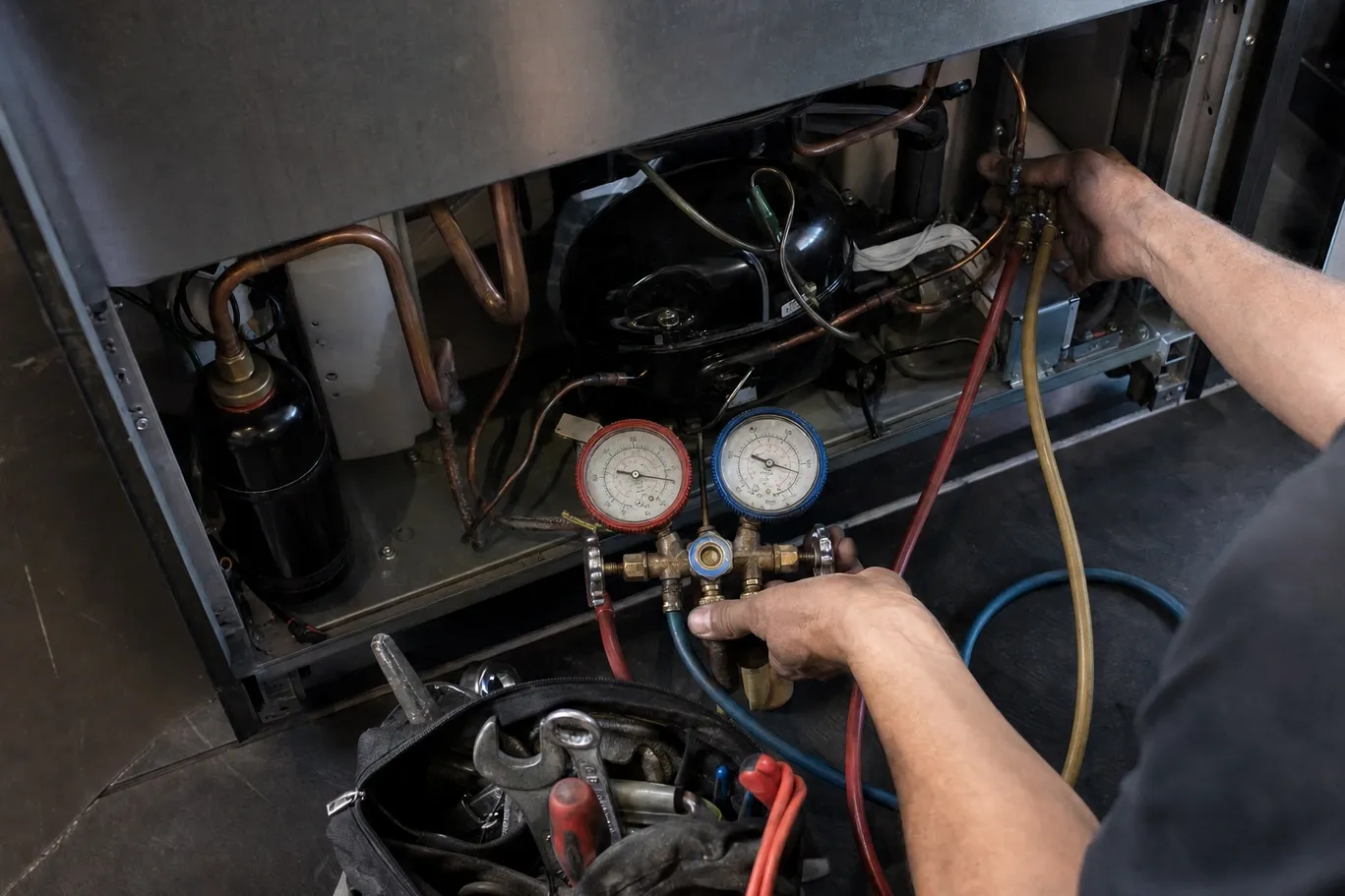
There is no one refrigerant for every Sub-Zero. The answer depends on the age of your unit, and the rating tag inside the cabinet names the exact type. Sub-Zero’s current use and care guides say outright that the appliance contains a flammable refrigerant and that only refrigeration technicians trained to handle flammable refrigerants may work on it. Built-ins from earlier decades ran on a non-flammable refrigerant instead. For a Phoenix homeowner the practical takeaway is the same either way: the refrigerant lives sealed inside tubing you never open, and if it is the reason your refrigerator has stopped cooling, the repair belongs to a qualified technician.
Finding the answer for your own unit
The rating tag lists the model, the serial number and the refrigerant, usually along with the amount sealed into the system. A built-in sits against a wall with its back hidden, so on most of these units the tag lives inside the cabinet; the use and care guide for your series shows the exact spot. If that guide carries a flammable-refrigerant warning, you own one of the newer units. In household refrigeration generally, the flammable refrigerants are hydrocarbons, most often isobutane, and they work in far smaller charges than the older types did.
What the refrigerant actually does
Think of the refrigerant as a courier for heat. The compressor squeezes it into a hot, high-pressure vapor and pushes it to the condenser, where it gives that heat off into your kitchen and turns to liquid. The liquid then passes through a narrow restriction, drops in pressure and boils inside the evaporator coil, soaking up warmth from the food compartment on the way. Back at the compressor, the loop starts over. Nothing is burned or consumed, so a healthy system keeps the same charge for its whole working life. A unit that is short of refrigerant has a leak somewhere, with no exceptions.
Many Sub-Zero models treat the refrigerator and freezer as two separate cooling jobs, which is one genuine difference from a typical single-evaporator refrigerator. The error codes show it: on 600, 648PRO and 700 Series units, EC40 flags excessive freezer compressor run, while EC50 flags excessive run on the refrigerator side. That split is why one compartment can drift warm while the other stays properly cold.
How a sealed system breaks down
Three failures cause most refrigerant trouble, and none of them is visible from the front of the unit.
| What fails | What you tend to notice | Who fixes it |
|---|---|---|
| A slow leak at a joint or coil | Cooling fades over days or weeks while the compressor runs nearly nonstop | Technician |
| A compressor that stops pumping | Clicking or humming with little cooling, or quiet with the lights still on | Technician |
| A blocked restriction | Temperatures creep upward even though the compressor keeps running | Technician |
Leaks tend to begin where tubing has rubbed against a bracket for years or where a joint has corroded. Compressors simply wear, and one that works hard in a hot room wears sooner. Phoenix summer afternoons routinely pass 110°F, and even with the air conditioning on, a kitchen can hold that heat well into the evening, so the condenser has less room to shed heat and the compressor runs longer to compensate.
Symptoms that look like lost refrigerant but often are not
A warm refrigerator does not automatically mean the charge is gone. A seized condenser fan, a failed defrost heater or a torn door gasket can leave the shelves just as warm, and those repairs cost a fraction of sealed-system work; a fan motor replacement, for example, typically runs $340–$720. If your freezer is cold while the fresh food side warms up, our guide to a warm refrigerator with a cold freezer walks through the likelier causes.
Sub-Zero’s own advice helps sort the cases. With EC40 and Service flashing, the cause can be a door left open, a fan or sensor fault, or the sealed system itself. If temperatures sit less than 10° above the set point, clean the condenser; if they are more than 10° above and no door was left ajar, schedule service, and do not clear the code while the numbers keep climbing. With EC50, a near-normal temperature means you can clean the condenser and hold the bell key for 15 seconds to clear it, but high temperatures call for a technician. Sub-Zero adds a useful cutoff: when the fresh food side shows more than 48 degrees with the control at 38, cleaning the condenser by itself will probably not bring it back, and service is the next step.
Checks worth five minutes before you call
- Settings. Classic (CL) and Designer (DET, DEC) controls arrive preset at 38°F for the refrigerator and 0°F for the freezer, adjustable one degree at a time. Make sure nobody nudged them.
- The display. If it reads 38° and 0° yet the unit is not cooling, Showroom Mode may be switched on, and Sub-Zero says to call its customer care line for that one.
- Doors and drawers. A drawer that did not quite latch keeps the system running hard. Check each seal by hand.
- The condenser. Monsoon dust storms push fine grit through every gap in a Phoenix house, and a coated condenser makes any cooling problem worse. A unit under 6 months old does not need cleaning yet; on older units, gentle vacuuming is the owner’s share of the job.
While you wait for a visit, keep the doors shut. By Sub-Zero’s estimate, an empty unit with no power typically needs 3 hours before the refrigerator section passes 45°F (7°C) and the freezer passes 20°F (-6°C), and a unit that has stopped cooling gives you a similar margin at best.
Why refrigerant work stays with a technician
There is no can-and-gauge shortcut on a Sub-Zero. Fixing a leak means locating it with detection equipment, recovering whatever charge remains, cutting out and brazing the damaged section, pulling a deep vacuum to remove moisture, and weighing in the exact charge listed on the tag. Too much or too little and the unit either cools poorly or strains its compressor. With a flammable refrigerant, an open flame near the tubing adds a real fire risk unless the system is properly cleared first, which is exactly why Sub-Zero limits that work to technicians with flammable-refrigerant training. Even the older non-flammable charges have to be captured with recovery equipment rather than released into the air.
Repair or replace: putting numbers on it
Every visit starts the same way: a flat $89 service call that covers the trip and a complete diagnosis, credited toward the repair once you approve it. If the diagnosis confirms a compressor or sealed-system fault, that repair typically runs $1,330–$3,180. A comparable built-in replacement typically costs several times that, so on a unit that is otherwise in good shape the repair usually makes sense. The firm quote comes after diagnosis, which lets you weigh the cost against the unit’s age and condition before deciding. For homes from Maryvale to Sunnyslope, our refrigerator repair service begins with that diagnosis in your kitchen; call (623) 469-9119 or use the booking button on this page.
Follow-up questions
Is the refrigerant in a Sub-Zero refrigerator flammable?
On current models, yes: the warnings printed in Sub-Zero's current manuals say the unit holds a flammable refrigerant, and they reserve any work on it for technicians trained in that kind of refrigerant. Older units built around a non-flammable refrigerant are still in plenty of homes, so the rating tag inside your unit is the place to confirm which one you have.
Can I add refrigerant to my Sub-Zero myself?
No. The refrigerant travels in a sealed loop and is never used up, so a low charge always means a leak that has to be found and repaired first. That takes brazing, a vacuum pump and a precisely weighed charge, and on newer units Sub-Zero restricts the job to technicians with flammable-refrigerant training.
Can a refrigerant problem hit only one compartment of a Sub-Zero?
Yes, on many models, because the two sides are cooled as separate jobs. On many Sub-Zero models the refrigerator and freezer have their own compressor run alerts and their own error codes, so trouble on one side need not touch the other. Even then, a fan, defrost or sensor fault turns up more often than a leak, which is why diagnosis comes before any quote.
How much does a Sub-Zero sealed-system repair cost in Phoenix?
A compressor or sealed-system repair typically runs $1,330–$3,180, depending on which part failed and where the leak is. Ahead of any repair there is a flat $89 charge for coming out and working out the fault, and it is subtracted from the repair bill when you approve the work; the firm price follows that diagnosis.
What is the difference between a Sub-Zero and a regular refrigerator?
The biggest mechanical difference is that many Sub-Zero units cool the refrigerator and freezer separately, while most ordinary refrigerators chill both from one evaporator and blow freezer air into the fresh food side. Sub-Zero built-ins are also made to sit flush with cabinetry, which puts the condenser behind a front grille or kickplate instead of at the back.