Wine Cooler Repair
Wine Cooler Circuit Board Replacement for Sub-Zero Owners
Wine cooler circuit board replacement swaps the control board that reads the zone sensors and switches the compressor and fans; on a Sub-Zero it typically costs $430–$920 once diagnosed. Here is how boards fail and when the culprit is really a sensor.
- Written by
- Warren Ibarra
- Trade
- Refrigeration technician — condenser and heat-load work · 20 years in the trade
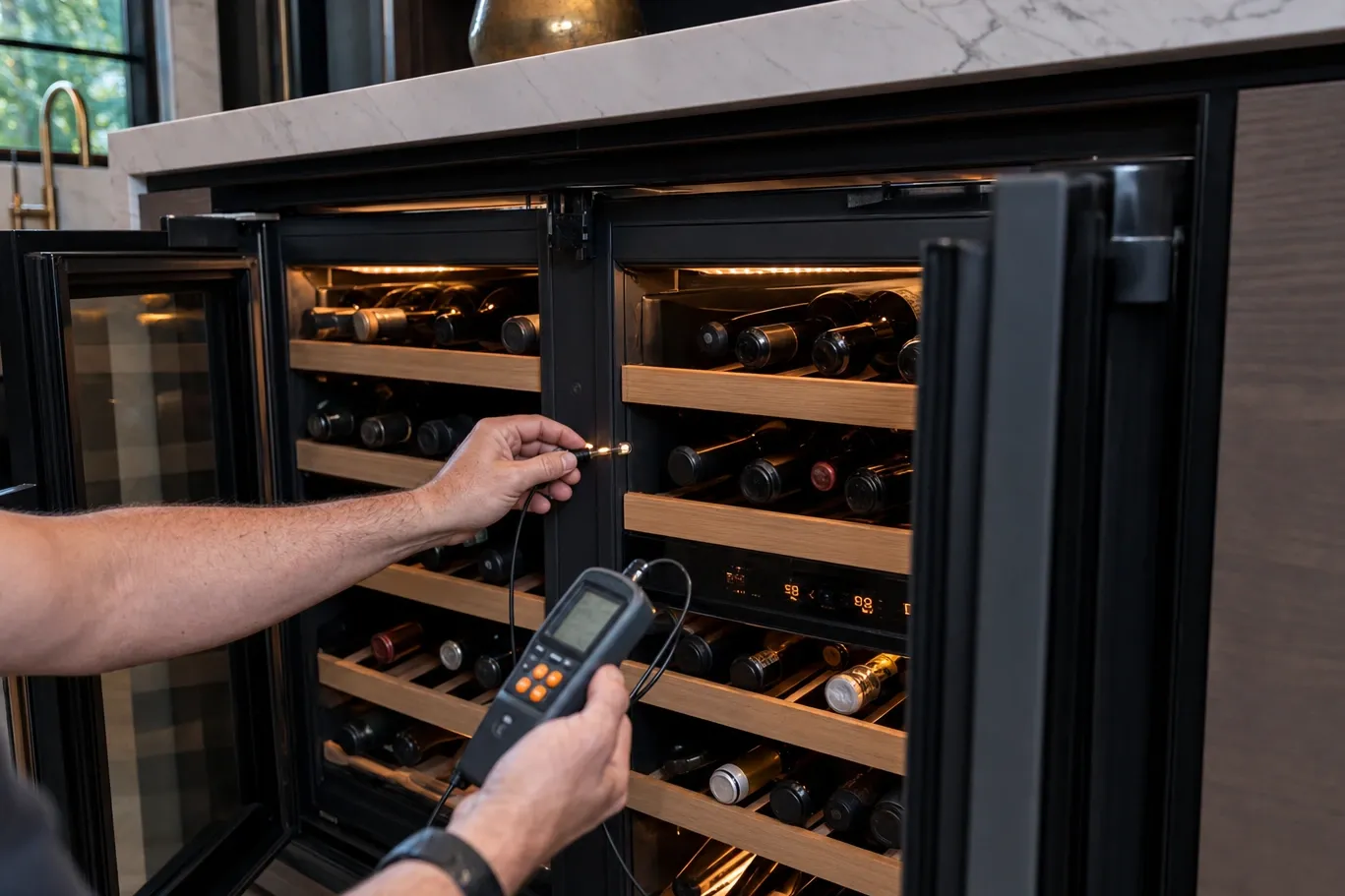
Wine cooler circuit board replacement means cutting the power, unclipping every wire harness from the old control board, fitting a board with the identical part number and then watching each zone pull down to its set temperature. On a built-in Sub-Zero wine unit that is normally a technician’s job, and a control board repair here typically lands at $430–$920 once the fault is confirmed. The catch is that plenty of suspected dead boards turn out to be something else. Phoenix summer afternoons climb past 110°F and monsoon storms flicker the power, and both produce symptoms that look electronic but get fixed without a new board.
What the control board does in a wine unit
Think of the board as thermostat, timer and switchboard rolled into one slab of circuitry. Small thermistors in each zone report temperature as a shifting electrical resistance. The board compares those readings with your setting (Sub-Zero Designer, Classic and UW-24 wine units accept anything from 39°F to 65°F, and either zone can hold red or white) and decides when the compressor, evaporator fan and condenser fan should run. Relays mounted on the board carry the actual current to those loads. The same board lights the display, reads the touch pads, times the door alarm and remembers fault codes.
On a dual-zone cabinet the board also picks which zone to cool first, so a brand-new Sub-Zero wine unit may chill only one zone at a time while it settles in. That is ordinary sequencing, not a defect.
How the boards actually fail
Almost every board failure traces back to heat, power or water.
- Heat. Electrolytic capacitors dry out faster when they sit warm for years. A condenser matted with lint and pet hair makes the whole machine compartment run hotter, and on many cabinets the electronics share that space. Domed or leaking capacitor tops are a common finding.
- Worn relays. Every compressor start snaps a relay contact shut. After thousands of cycles the contacts pit; they may weld closed, so the compressor never stops and the bottles chill like milk, or burn open, so it never starts at all.
- Power events. Lightning during the summer monsoon, and the brownouts that ride along with it, can take out a fuse, a voltage regulator or the microcontroller itself.
- Moisture. A blocked drain or a tired gasket lets condensate collect where it should not, and green corrosion on connector pins then causes faults that come and go.
Signs that point at the board, and signs that do not
| What you see | Board likely? | Other common cause |
|---|---|---|
| Blank display, outlet has power | Often | Tripped breaker or loose plug |
| Buttons ignored or display scrambled | Often | Moisture behind the touch panel |
| Compressor runs nonstop, wine too cold | Sometimes | Faulty zone sensor |
| Lights on, no cooling at all | Sometimes | Dirty condenser or failed fan |
| Water on the floor | Rarely | Clogged drain or worn door seal |
Fault codes are the best clue you have. On Classic (BW) wine storage, EC 05 and EC 07 mean the upper or lower cabinet thermistor has read open, shorted or erratic, and EC 06 and EC 08 point at the matching evaporator sensors. Those are sensor repairs, typically $280–$630 in our area, and a new board would not cure them. A Designer Wine (IW) showing 40 1 09 is reporting that zone 1 has drifted far too warm or too cold; kill its circuit for half a minute, and book a visit only when that code reappears. Sub-Zero undercounter wine units also carry one error that flags a problem in the control’s original programming. The same reset applies, and if it comes back the board becomes the prime suspect, since the maker offers no other owner check for it.
Rule out the cheap causes first
Before paying for electronics, work through these in order:
- Confirm the outlet and breaker. A tripped GFCI in a wet bar or garage silences the unit just as completely as a dead board.
- Cut power at the breaker for 30 seconds, then restore it. Many control glitches left behind by a monsoon flicker clear right here.
- Check the room. Sub-Zero asks that the space around some of its wine units stay between 60°F and 90°F, and a Maryvale or Sunnyslope garage in July sails past that ceiling by early afternoon.
- Clean the condenser if three months have passed since the last cleaning, then allow a full 24 hours before judging the temperature.
- If your unit flashes Service, the control has deliberately stopped cooling after the compressor ran too long. Turn it off, clean the condenser, make sure nothing props the door open, and turn it back on; temperatures should settle within 24 hours. That lockout is the board doing its job, not failing at it.
Our troubleshooting guides cover other symptoms if none of this applies to your cabinet.
Is it a DIY job?
On an inexpensive freestanding cooler, a handy owner can sometimes manage the swap: unplug it, photograph every connector, move the plugs one at a time to a board with the identical part number, and hold the new board by its edges to avoid static. Universal boards sold online look tempting, but they are built around basic single-zone controls and seldom match the original connectors or sensor values.
A built-in Sub-Zero is a different proposition. The unit often has to be eased out of its cabinetry or opened behind a grille, the relay side of the board carries line voltage, and the real work is the diagnosis that comes before any swap: measuring each thermistor’s resistance, checking whether a relay is truly sending power to the compressor and fans, and reading the stored codes. Replace a board on a hunch and the original fault, whether a sensor, a fan or the sealed system, is still sitting there behind a bill of several hundred dollars.
What it costs, and when repair stops making sense
Every Sub-Zero wine cooler repair we do begins with a flat $89 visit that includes the full diagnosis and is credited toward the work once you approve it. Typical figures in Phoenix:
- Electronic control board: $430–$920
- Thermistor or sensor: $280–$630
- Evaporator or condenser fan motor: $340–$720
- Compressor or sealed-system repair: $1,330–$3,180
The firm price comes only after the fault is pinned down. Even the top of the board figure is a small slice of what a comparable built-in replacement costs, so a board failure on its own is almost never a reason to retire a Sub-Zero. After the new board goes in, look after it: keep the condenser clean and put the outlet behind a good surge protector before monsoon season starts. If your wine unit lives in a Coronado bungalow kitchen, a Roosevelt Row condo or a Sunnyslope den, the number for a diagnostic visit is (623) 469-9119.
Follow-up questions
How much does wine cooler circuit board replacement cost?
On a Sub-Zero wine unit, an electronic control board repair typically runs $430–$920 for the part and the fitting, and the firm figure is given only after the fault is confirmed. Before that, our technician's trip and testing cost a flat $89, which comes off the board bill when you say yes.
Can I put a universal circuit board in my wine cooler?
Not in a Sub-Zero. Universal boards sold online are designed for small freestanding coolers with a single sensor and a simple relay, so they are not built to run the zone sensors, alarms and fans of a built-in unit. Even on a budget cooler, the board has to match the original part number and connector layout exactly.
How do I tell a bad board from a bad temperature sensor?
Read the display first, because a code that names a thermistor points at a sensor rather than the board. On Classic BW wine storage, EC 05 and EC 07 flag the upper or lower cabinet sensor, while EC 06 and EC 08 flag the evaporator sensors. A blank display with live power, ignored buttons or a compressor that never rests are more typical of a failed board.
Why is my wine cooler not cooling when the lights still work?
Working lights only prove the cabinet has power; cooling depends on the board switching the compressor and fans, and those circuits can fail on their own. Before blaming electronics, clean the condenser if three months have gone by, make sure the room stays between 60°F and 90°F, and give the unit 24 hours to recover.
Is a leaking or noisy wine cooler a circuit board problem?
Usually not. Water on the floor normally comes from a blocked defrost drain or a door that no longer seals, and most hums and rattles come from a fan or the compressor. Rapid clicking with no compressor start is the exception, since a worn relay on the board and a weak starting component both sound like that.